The story of Peter McLagan MP, a man who broke the mould
Kirsteen Sullivan MP
When I arrived in Bathgate for my first ever constituency surgery, just three weeks after the election, I wasn’t too sure what to expect. Having served as a councillor, I was no stranger to challenging casework – however, it was fair to say, I didn’t see this one coming.
My seat has a proud political history. Bathgate is no stranger to influential political figures. The affection and respect in which Tam Dalyell is held to this day is something to which I can only aspire.
Another long-standing representative of the constituency has a lesser-known story: Peter McLagan. From 1865, he was the MP for ‘Linlithgowshire’ for 28 years and a man who broke the mould. When constituent and avid local historian David Main walked through the doors of Bathgate Partnership Centre, he brought his contagious enthusiasm for Peter’s story with him.
Born in what was then called ‘British’ Guiana in 1823 to a Scottish plantation manager and a Black mother, Peter’s journey to Parliament was extraordinary. At a time when the British Empire was still grappling with the abolition of slavery, Peter’s mixed-race heritage made him an unlikely figure to enter public life. However, when he was elected, he became Scotland’s first non-white Member of Parliament.
It is important to acknowledge that he was a product of his privilege and a complex individual. He supported women’s suffrage in a male-dominated world and was an advocate for women’s education. Neither of these were popular positions at the time. While he held some progressive views and gave his voice to movements that were far ahead of their time, he often occupied stances that are deeply unpalatable. His attitudes toward imperialism and the circumstances of his wealth (inherited from his slave-owning father) are a reminder of the honest conversations we must have about our history.
Peter McLagan’s story is a vital, but often forgotten, part of our political heritage. Much of his political style was considered innovative at the time but commonplace to us now. For example, he often held surgeries in markets and pubs to hear the opinions of his constituents before voting, as many of us continue to do today.
David told me that the Parliamentary Archives held one of the few portraits of McLagan, but he was omitted from The Pioneers display in the corridor leading to the public gallery. David had been campaigning for four years to get Peter McLagan recognised and have his portrait installed. I was only too glad to pick up the mantle and correct this omission.
As a new MP, I had no idea who to contact or how to request a change in the display. Thanks to the Commons Library, I discovered I had to direct my request to the Speaker’s Advisory Committee on Works of Art. It was then a matter of waiting for the committee to reconvene after the election. I then put my request in writing to the chair of the committee, the deputy speaker Caroline Nokes.
I am pleased that the committee recognised the omission, and the portrait is now proudly displayed.
The corridor leads from Central Lobby and up the stairs to the gallery, meaning every visitor will walk that hall to watch our democracy in action. We are reminded of the people who broke the mould and made the story of British democracy worth telling. Peter McLagan now has the recognition he deserves thanks to David Main walking into my surgery in July 2024. A little bit of Parliament’s story will always be richer thanks to Linlithgowshire’s pioneer MP.
This article appeared in The House Magazine on 8th October 2025
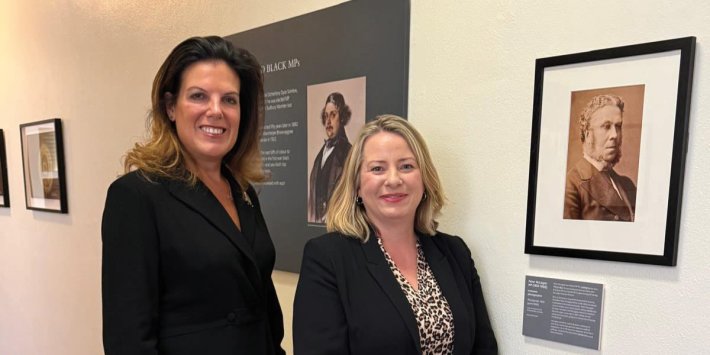
Deputy speaker Caroline Nokes MP, Kirsteen Sullivan MP, and the portrait of Peter McLagan
Constituency Office Address
62 Hopetoun Street, Bathgate, West Lothian, EH48 4PD